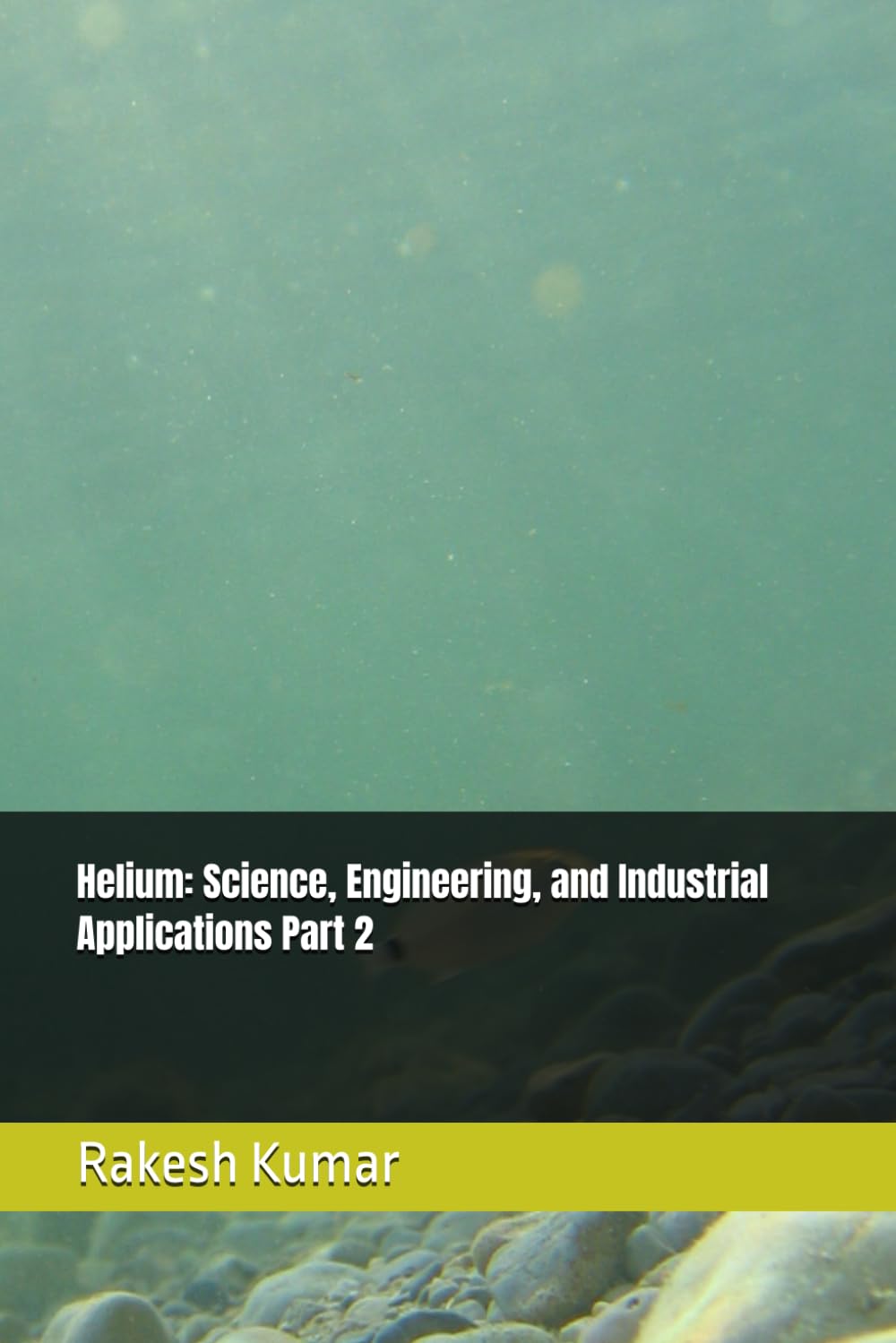
capítulo por capítulo baixar Helium: Science, Engineering, and Industrial Applications Part 2
por Rakesh Kumar
Leia uma amostra
Helium: Science, Engineering, and Industrial Applications Part 2
Helium is one of nature's most remarkable elements. Although it is the second most abundant element in the universe after hydrogen, it is surprisingly rare on Earth, making it one of the world's most valuable and strategically important natural resources. From powering scientific discoveries to enabling cutting-edge technologies, helium has become indispensable in modern industry, medicine, research, and space exploration.
Discovered in the Sun before it was found on Earth, helium derives its name from the Greek word Helios, meaning "Sun." This unique history reflects its cosmic significance. Formed primarily during the Big Bang and continuously produced within stars through nuclear fusion, helium has played a vital role in the evolution of the universe for billions of years. On Earth, most commercially available helium originates from the radioactive decay of uranium and thorium deep within the Earth's crust, where it gradually accumulates in selected natural gas reservoirs over geological timescales.
What makes helium truly extraordinary is its unique combination of physical and chemical properties. It is chemically inert, non-toxic, non-flammable, lighter than air, possesses exceptionally high thermal conductivity, and has the lowest boiling point of any element at approximately 4.22 Kelvin (-268.93°C). These characteristics make helium indispensable wherever extreme purity, ultra-low temperatures, or contamination-free environments are required.
Today, helium supports an astonishing range of technologies that influence our daily lives. Hospitals rely on liquid helium to cool superconducting magnets used in Magnetic Resonance Imaging (MRI) systems, enabling non-invasive medical diagnosis. Semiconductor manufacturers use helium to fabricate advanced computer chips and electronic devices with nanometer precision. Scientists depend on helium to cool particle accelerators, quantum computers, and superconducting research facilities. Aerospace engineers utilize helium in rocket propulsion systems, spacecraft pressurization, satellite manufacturing, and cryogenic testing. Manufacturers employ helium for precision welding, leak detection, laser technologies, fiber-optic production, and high-performance industrial processes.
Despite its many applications, helium is a finite natural resource. Unlike renewable materials, once helium escapes into the Earth's atmosphere, it gradually disperses into space and cannot be economically recovered. Growing global demand, combined with limited natural reserves and increasing technological dependence, has elevated helium from an industrial gas to a strategically important resource. Efficient exploration, extraction, purification, storage, recycling, and conservation have therefore become essential topics for governments, industries, and researchers worldwide.
This book has been written to provide a comprehensive understanding of helium from both scientific and engineering perspectives. It begins by exploring helium's origin, atomic structure, physical and chemical properties, and occurrence in nature. The book then examines modern exploration methods, extraction technologies, liquefaction processes, cryogenic engineering, and storage systems. Subsequent chapters discuss helium's pivotal role in superconductivity, medical imaging, semiconductor manufacturing, aerospace engineering, defense technologies, scientific research, quantum computing, energy systems, environmental monitoring, welding, leak detection, and numerous other industrial applications.
Special emphasis has been placed on explaining engineering principles in a clear and practical manner. Each chapter combines fundamental concepts with real-world industrial applications, supported by technical explanations, process descriptions, diagrams, tables, and illustrative examples.
Procurando Helium: Science, Engineering, and Industrial Applications Part 2? Aqui você encontra tudo sobre este livro de Rakesh Kumar. Nesta página estão a descrição da obra, os detalhes da edição (616 páginas) e os formatos disponíveis para baixar: pdf, ibook, epub, kindle. Se você gosta de Livros Internacionais, Ciências Tecnológicas, Química, Industrial & Técnico, explore também outros títulos da mesma categoria no Porto do livro Português. Veja ainda as outras obras de Rakesh Kumar em nosso catálogo.









Autores populares
Icon Group International (285) Publishing lmgdaw (262) Nikolay Krechet (164) Kennie B Journals (112) Riddler Books (98) Charles Nehme (95) webmarbook design (95) Mint and Cherry Notebooks (79) Iwona Makara (76) Mary Hirose (75) NAK Legal Publishing (74) Jillo Trukudo (73) Just Visualize It (69) Quick Witted Coconut (67) Talor Press (67) matlasor Sticker's (64) Miller Sye (63) Moonpeak Library (63) Ondrej Sarek (63) Roggie Clark (63)Principais publicadores
Forgotten Books Independently published Routledge Dover Publications CRC Press Taschen Princeton University Press Wiley Oxford University Press Springer Cambridge University Press Kessinger Publishing Thames & Hudson Gale, U.S. Supreme Court Records Bloomsbury Academic O'Reilly Media Rizzoli International Publications Hal Leonard Publishing Corporation Tuttle Publishing Editorial Tirant lo Blanch