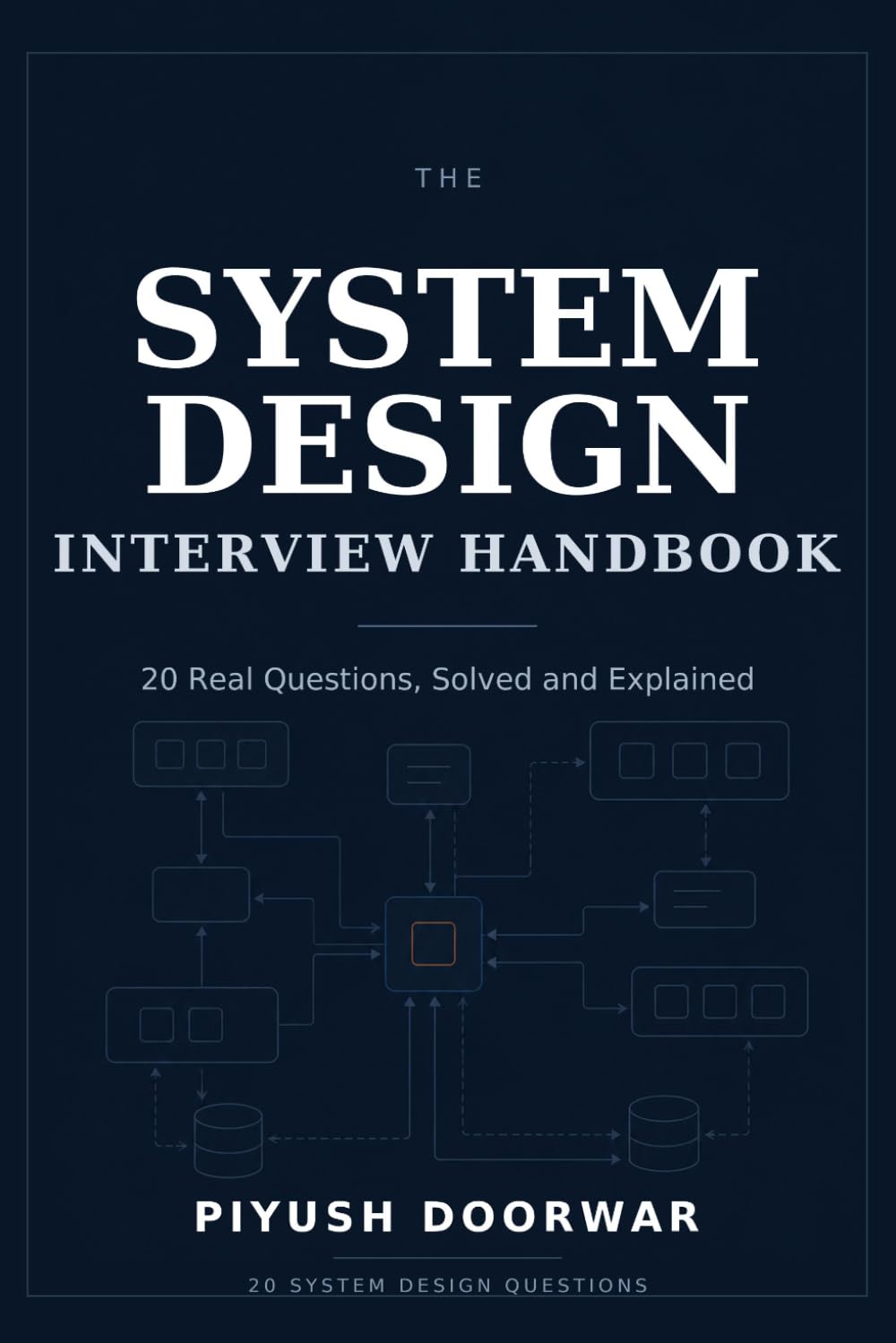
capítulo por capítulo baixar System Design Interview Handbook: 20 Real Questions, Solved and Explained
por Piyush Doorwar
System Design Interview Handbook: 20 Real Questions, Solved and Explained
A friend of mine failed a design round after four months of preparation. He could draw the Twitter timeline from memory. Then the interviewer asked him to design a system for sending SMS reminders to patients before their appointments, and he froze, because it was not on his list.
He knew every piece he needed. He had them filed under three different chapter headings.
This book is organised the other way round. It builds one running inventory of 108 numbered tools across 20 design problems, and no concept is ever explained twice. Chapter 9 teaches consistent hashing properly, once. Chapter 12 reaches for it by number and spends its pages on what is actually new. By the last question you already own most of what any unfamiliar problem needs, which is the only preparation that survives an interviewer who changes the requirements halfway through.
The twenty problems.
URL shortener, distributed cache, rate limiter, web crawler, key-value store, login and sessions, news feed, chat, notifications, message queue, ride sharing, ticket booking, payments, file sync, video streaming, collaborative editor, search and typeahead, ad click aggregator, metrics and monitoring, and an LLM chat service.
Every chapter follows the same routine.
Clarifying questions, requirements with a number attached to each one, back-of-envelope arithmetic with the working shown, a deliberately simple baseline, the specific number that breaks it, then one or two concepts taught in real depth, then the improved design and what it cost you.
The numbers were checked in 2026, not copied from 2012.
The latency table everyone still quotes is stale in ways that change decisions. YouTube's press page no longer says 500 hours per minute. Kafka removed ZooKeeper entirely in March 2025. ScyllaDB is not open source any more, and "Redis" now means one of three different things. Where a figure has never been published, this book says so and derives one instead of inventing it.
Real engineering history, with the specifics.
Discord going from 177 Cassandra nodes to 72. Notion choosing 480 shards because of its factor count. Figma spending nine months to shard a single table. Ticketmaster absorbing 3.5 billion requests in one onsale.
Including what interviewers started asking recently.
Continuous batching, paged KV caches, token-based rate limiting for LLM APIs, HNSW, and retrieval-augmented generation, because OpenAI and Anthropic are now among the companies generating the most reported design questions.
Written for engineers with three to eight years of backend experience who have shipped services but never designed for a hundred million users.
The appendix is the whole book compressed: 108 tools, one line each, four pages. Read it the night before.
Procurando System Design Interview Handbook: 20 Real Questions, Solved and Explained? Aqui você encontra tudo sobre este livro de Piyush Doorwar. Nesta página estão a descrição da obra, os detalhes da edição (358 páginas) e os formatos disponíveis para baixar: pdf, ibook, epub, kindle. Se você gosta de Livros Internacionais, Computação, Informática e Mídias Digitais, Análise de Sistemas e Design, explore também outros títulos da mesma categoria no Porto do livro Português. Veja ainda as outras obras de Piyush Doorwar em nosso catálogo.











Autores populares
Icon Group International (285) Publishing lmgdaw (262) Nikolay Krechet (164) Kennie B Journals (112) Riddler Books (98) Charles Nehme (95) webmarbook design (95) Mint and Cherry Notebooks (79) Iwona Makara (76) Mary Hirose (75) NAK Legal Publishing (74) Jillo Trukudo (73) Just Visualize It (69) Talor Press (68) Quick Witted Coconut (67) matlasor Sticker's (64) Miller Sye (63) Moonpeak Library (63) Ondrej Sarek (63) Roggie Clark (63)Principais publicadores
Forgotten Books Independently published Routledge Dover Publications CRC Press Taschen Princeton University Press Wiley Oxford University Press Springer Cambridge University Press Kessinger Publishing Thames & Hudson Gale, U.S. Supreme Court Records Bloomsbury Academic O'Reilly Media Rizzoli International Publications Hal Leonard Publishing Corporation Tuttle Publishing Editorial Tirant lo Blanch