capítulo por capítulo baixar Terroir: From Place to Phenotype
por Vladimir Semkovich
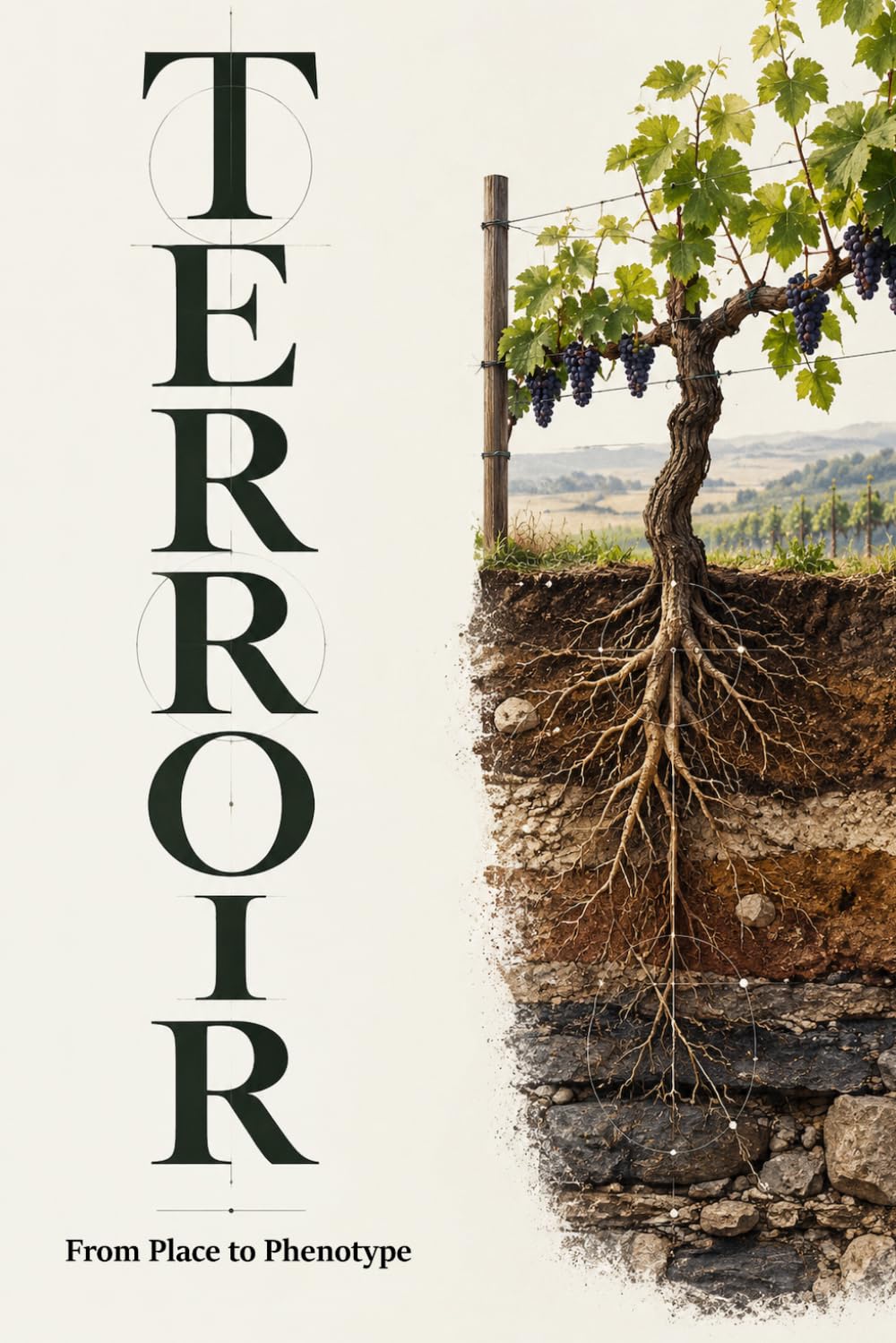
Terroir: From Place to Phenotype
What is terroir, really? For centuries, terroir has been used to explain why neighbouring vineyards can produce wines with different identities. Soil, climate, geography, tradition and human practice are often treated as the ingredients of a single idea. But a vineyard is not a static piece of land, and wine is not a direct chemical imprint of soil. Terroir. From Place to Phenotype examines terroir as a dynamic biological and environmental system, and asks a more difficult question: can the influence of place be traced through measurable mechanisms from the vineyard to the wine? The book begins with the historical meaning of terroir and follows the scientific evolution of the concept, from traditional soil-and-climate descriptions to quantitative viticulture. Heat accumulation, rainfall, water status, nitrogen availability, phenology and soil measurements have given viticulture powerful predictive tools. Yet these measurements also reveal a limitation: the same regional climate can produce very different physiological conditions within individual vines. The Barossa Valley (Australia) becomes a natural laboratory for examining that problem. Its contrasting elevations, soils, water systems, vineyard histories, management practices and wine styles provide an unusually useful setting for asking how different scientific maps describe the same landscape, and why those maps do not always agree. At the centre of the book is the rhizosphere, the narrow zone of soil directly influenced by living roots. Here, roots release carbon compounds, microorganisms compete and cooperate, nutrients are transformed, signalling molecules move between organisms, and soil conditions are translated into something the vine can actually experience. Modern sequencing has revealed enormous microbial diversity in vineyards, but identifying organisms is not the same as demonstrating what they do. Functional potential is not activity, and activity is not automatically a causal effect on the plant. The book therefore moves beyond microbiome inventories into vine physiology. Water potential, stomatal regulation, photosynthesis, hydraulic dysfunction, embolism, abscisic acid, heat stress, recovery and stress history are examined as interacting processes rather than isolated measurements. Particular attention is given to a problem often hidden by seasonal averages: the order, duration and repetition of stress events may matter as much as the total amount of stress. A vine exposed to one hot day is not necessarily physiologically equivalent to a vine exposed to the same temperature repeatedly over several weeks. This leads to another deceptively simple question: What does it actually mean for a grape to be ripe? Sugar accumulation, organic-acid metabolism, anthocyanins, tannins, aroma compounds and berry water balance do not necessarily mature at the same rate. Heat, drought, carbon limitation and vine history can uncouple processes that are often compressed into a single number such as °Brix. Ripeness, therefore, is treated not as one clock but as several biological processes whose trajectories can diverge. Finding that a soil microbiome differs between vineyards does not prove that microbes caused differences in wine. Along the way, Terroir. From Place to Phenotype explores climate accumulation, plant-water relations, grapevine phenology, vineyard microbiology, root exudates, microbial functional genes, nitrogen and sulfur cycling, mycorrhizal interactions, plant signalling, heat stress, berry development, old-vine biology, clonal history, trunk disease, measurement error and causal inference. Terroir may not be a substance hidden in the soil. It may be the measurable history of interactions between place, water, roots, microorganisms, the vine, the berry and time – expressed, imperfectly, in the wine.
Procurando Terroir: From Place to Phenotype? Aqui você encontra tudo sobre este livro de Vladimir Semkovich. Nesta página estão a descrição da obra, os detalhes da edição (323 páginas) e os formatos disponíveis para baixar: pdf, ibook, epub, kindle. Se você gosta de Livros Internacionais, Ciências Tecnológicas, Ciências Agrárias, Ciência do Solo, explore também outros títulos da mesma categoria no Porto do livro Português. Veja ainda as outras obras de Vladimir Semkovich em nosso catálogo.












Autores populares
Icon Group International (285) Publishing lmgdaw (262) Nikolay Krechet (164) Kennie B Journals (112) Riddler Books (98) Charles Nehme (95) webmarbook design (95) Mint and Cherry Notebooks (79) Iwona Makara (76) Mary Hirose (75) NAK Legal Publishing (74) Jillo Trukudo (73) Just Visualize It (69) Quick Witted Coconut (67) Talor Press (67) matlasor Sticker's (64) Miller Sye (63) Moonpeak Library (63) Ondrej Sarek (63) Roggie Clark (63)Principais publicadores
Forgotten Books Independently published Routledge Dover Publications CRC Press Taschen Princeton University Press Wiley Oxford University Press Springer Cambridge University Press Kessinger Publishing Thames & Hudson Gale, U.S. Supreme Court Records Bloomsbury Academic O'Reilly Media Rizzoli International Publications Hal Leonard Publishing Corporation Tuttle Publishing Editorial Tirant lo Blanch