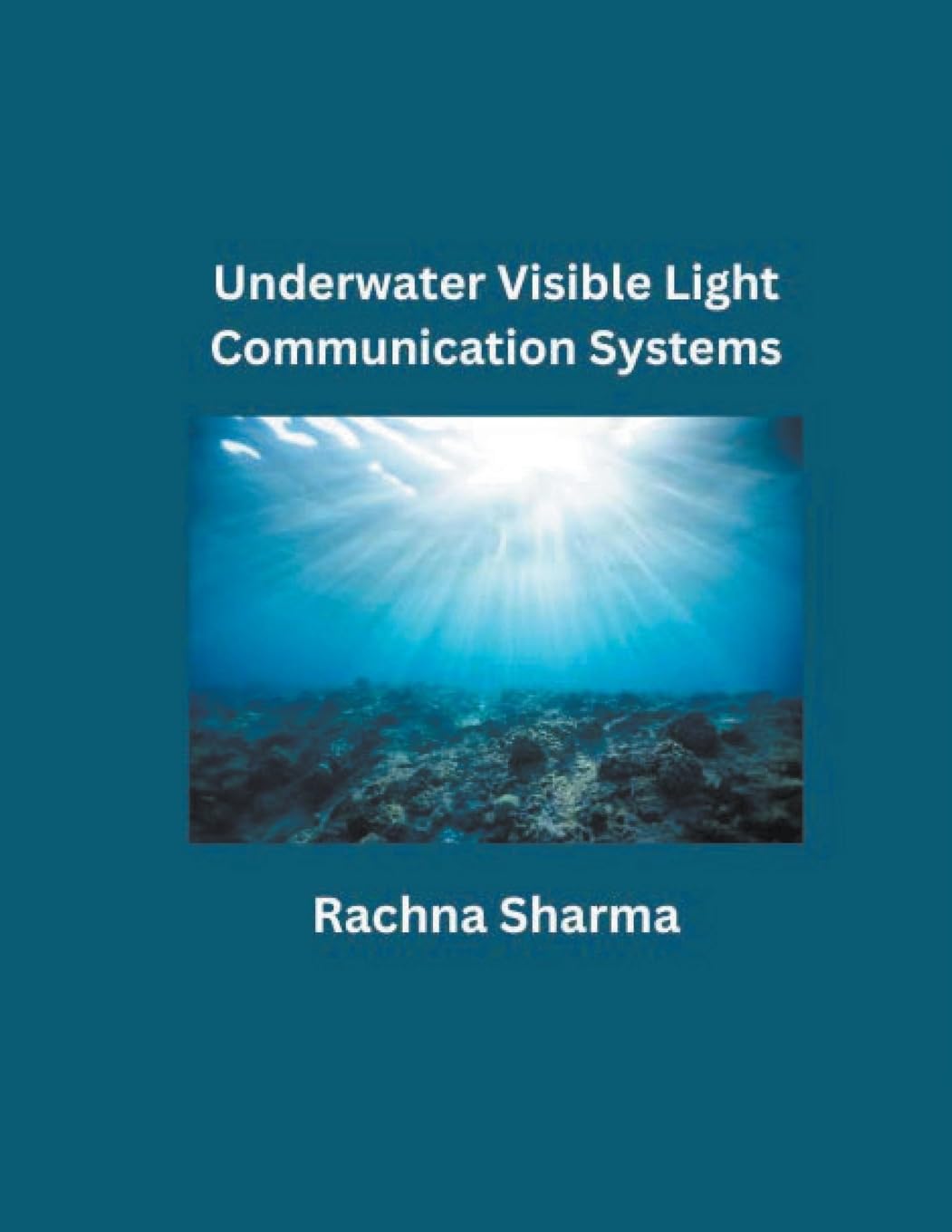
capítulo por capítulo baixar Underwater Visible Light Communication Systems
por Rachna Sharma
Underwater Visible Light Communication Systems
Underwater wireless communication system designers have been confronted with an ever-increasing need for high-capacity and high-data-rate wireless applications for real-time image and video transmission. Acoustic wireless communication (AWC) has been preferred inside the water over a long-range communication (a few kms). However, due to having a drawback of low data rate (upto kbps) in AWC, the visible light communication (VLC) is growing attention as an attractive alternative to AWC, as VLC supports high data rate. Different sorts of light transmissions, such as horizontal, vertical, and slant, are possible. When visible light travels through an underwater channel, it encounters a variety of negative factors due to the interaction of the light wave with underwater constituents. Path loss and turbulence are two of the most critical factors that cause severe fading. Path loss quantifies the amount of power a signal loses as it travels through a communication channel. Underwater turbulence occurs due to the change in refractive index of the water, thereby causing random fluctuations in the received signal strength. This phenomenon is referred as turbulence-induced fading. The main cause of change in refractive index is variation of temperature, eddy particles and pressure inside water. Since surface of the sea is directly imposed with sun rays and due to which the temperature of the surface water is higher as compared to the temperature of deeper dark water. Visible Light Communication refers to optical wireless communication systems that operate in the visible band (390 - 750 nm). LEDs or lasers are used in VLC systems because they can be pulsed at very high speeds without affecting the lighting output or the human eye. The use of LEDs is a sustainable and energy- efficient strategy for both illumination and communication. The properties of sea water are transparent to blue and green light (450 nm to 530 nm) and exhibit low attenuation. Underwater VLC is able to provide data rate up to Gbps in a real-time environment. In the Underwater VLC system, spatial diversity has proven to be an effective and widely used technique to alleviate the effects of fading and improve the performance of communication systems. In spatial diversity, several parallel communication links are formed between transmitter and receiver by employing multiple transmit and/or receive branches (MIMO systems).
Procurando Underwater Visible Light Communication Systems? Aqui você encontra tudo sobre este livro de Rachna Sharma, publicado por MOHAMMED ABDUL SATTAR. Nesta página estão a descrição da obra, os detalhes da edição (118 páginas) e os formatos disponíveis para baixar: pdf, ibook, epub, kindle. Se você gosta de Livros Internacionais, Engenharia e Transporte, Engenharia, Elétrica e Eletrônica, Desenho Digital, explore também outros títulos da mesma categoria no Porto do livro Português. Veja ainda as outras obras de Rachna Sharma em nosso catálogo.









Autores populares
Icon Group International (285) Publishing lmgdaw (262) Nikolay Krechet (164) Kennie B Journals (112) Riddler Books (98) Charles Nehme (95) webmarbook design (95) Mint and Cherry Notebooks (79) Iwona Makara (76) Mary Hirose (75) NAK Legal Publishing (74) Jillo Trukudo (73) Just Visualize It (69) Quick Witted Coconut (67) Talor Press (67) matlasor Sticker's (64) Miller Sye (63) Moonpeak Library (63) Ondrej Sarek (63) Roggie Clark (63)Principais publicadores
Forgotten Books Independently published Routledge Dover Publications CRC Press Taschen Princeton University Press Wiley Oxford University Press Springer Cambridge University Press Kessinger Publishing Thames & Hudson Gale, U.S. Supreme Court Records Bloomsbury Academic O'Reilly Media Rizzoli International Publications Hal Leonard Publishing Corporation Tuttle Publishing Editorial Tirant lo Blanch