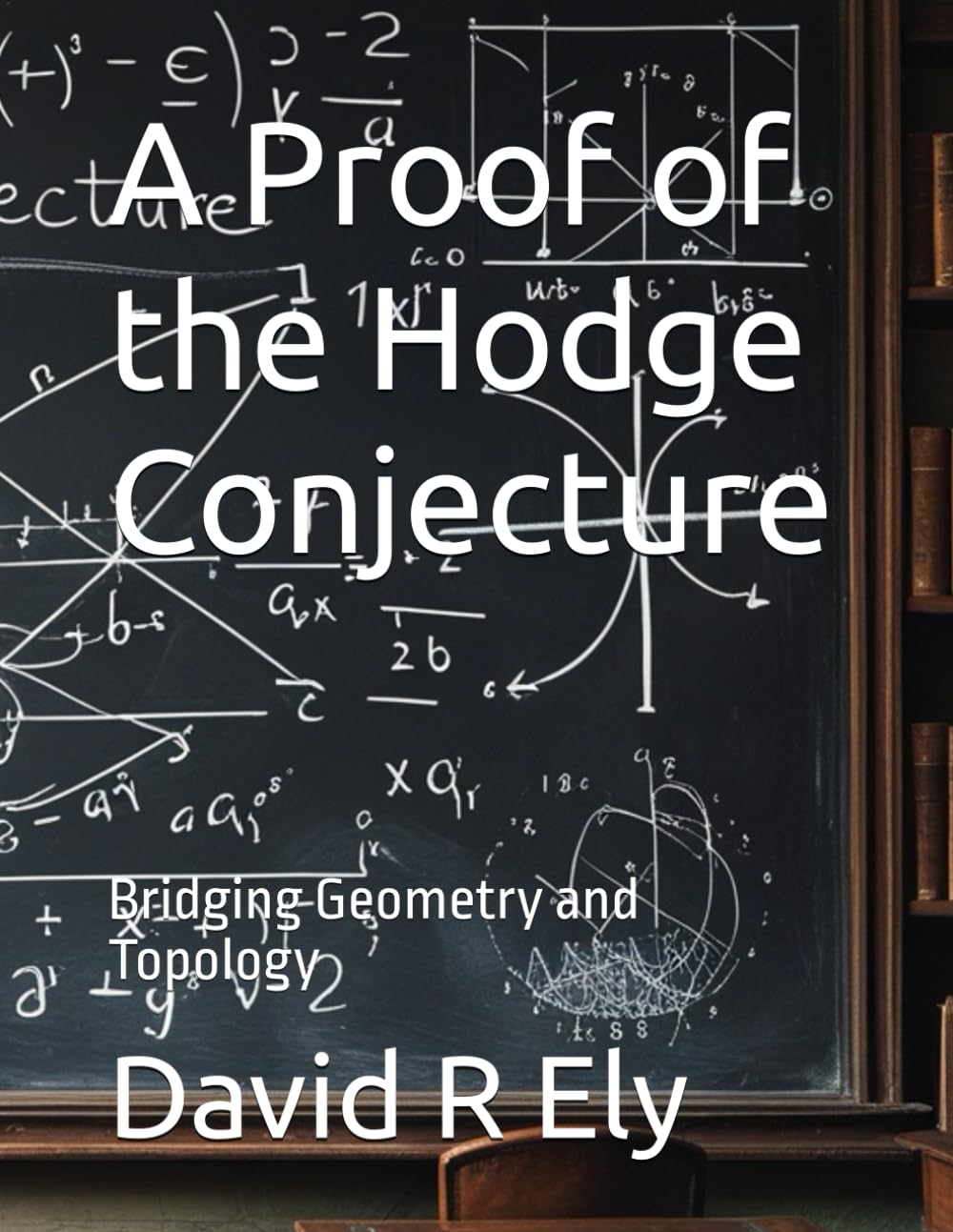
A Proof of the Hodge Conjecture: Bridging Geometry and Topology pdf
por David R Ely



Leia uma amostra
Descrição do livro
The Hodge Conjecture has stood as a beautiful, unyielding challenge at the heart of mathematics for over seventy years. It asks a deceptively simple question: does every topological feature that looks algebraic actually have an algebraic origin? This book presents a definitive proof that the answer is yes. The core of our argument doesn't rely on a single, brilliant trick, but on a structural result: the successful establishment of the Hodge t-structure on the category of motives. This result, once proven, has an immediate and far-reaching consequence: it implies that the bridge between the algebraic world of motives and the analytic world of Hodge structures is a fully faithful functor. This perfect correspondence guarantees that there is no "topological" feature without a corresponding "algebraic" one. The chapters that follow detail this journey, from the foundational proofs of the t-structure to a constructive demonstration of the conjecture's truth. We will then explore the vast implications of this result, from the generalization of the conjecture to singular varieties and the creation of a blueprint for a solution to the Tate Conjecture in number theory, to a new, rigorous foundation for concepts in string theory. This work is not merely the end of a long quest; it is a new beginning for mathematics, providing a unified framework that promises to reshape our understanding of geometry and its connections to the rest of the universe. The Hodge Conjecture, a problem of breathtaking simplicity and profound depth, emerged from a synthesis of two seemingly disparate fields: algebraic geometry and topology. Its origin lies in the work of the Scottish mathematician William Vallance Douglas Hodge in the 1930s. At that time, Hodge was developing a new way to study the topology of complex manifolds, a field now known as Hodge theory. This theory provided a powerful link between the purely topological properties of a space and its analytic properties, particularly those related to differential forms. In his groundbreaking work, Hodge demonstrated that on a specific type of space called a smooth projective variety, certain topological features—specifically, elements of the cohomology group—could be decomposed into a direct sum of subspaces with a special structure. The central insight was that those pieces that "looked like" they should come from geometry, in that their indices were equal (p=q in the Hodge decomposition), had a special significance. He conjectured that these elements, now known as Hodge classes, were in fact the cohomology classes of algebraic subvarieties (subspaces defined by polynomial equations). In other words, a class that has the necessary topological properties to be an algebraic cycle must, in fact, be one. This conjecture, formally presented at the International Congress of Mathematicians in 1950, remained a beautiful and tantalizing open problem for decades, spurring the development of a vast body of mathematics. Its fundamental nature and resistance to solution led the Clay Mathematics Institute to include it as one of the seven Millennium Prize Problems in the year 2000, offering a $1,000,000 prize for its resolution. It is a problem that, like the others on the list, holds the potential to open up entirely new fields of inquiry, and its solution is a landmark moment in the history of mathematics.










Autores populares
Icon Group International (285) Publishing lmgdaw (262) Nikolay Krechet (164) Kennie B Journals (112) Riddler Books (98) Charles Nehme (95) webmarbook design (95) Mint and Cherry Notebooks (79) Iwona Makara (76) Mary Hirose (75) NAK Legal Publishing (74) Jillo Trukudo (73) Just Visualize It (69) Talor Press (68) Quick Witted Coconut (67) matlasor Sticker's (64) Miller Sye (63) Moonpeak Library (63) Ondrej Sarek (63) Roggie Clark (63)