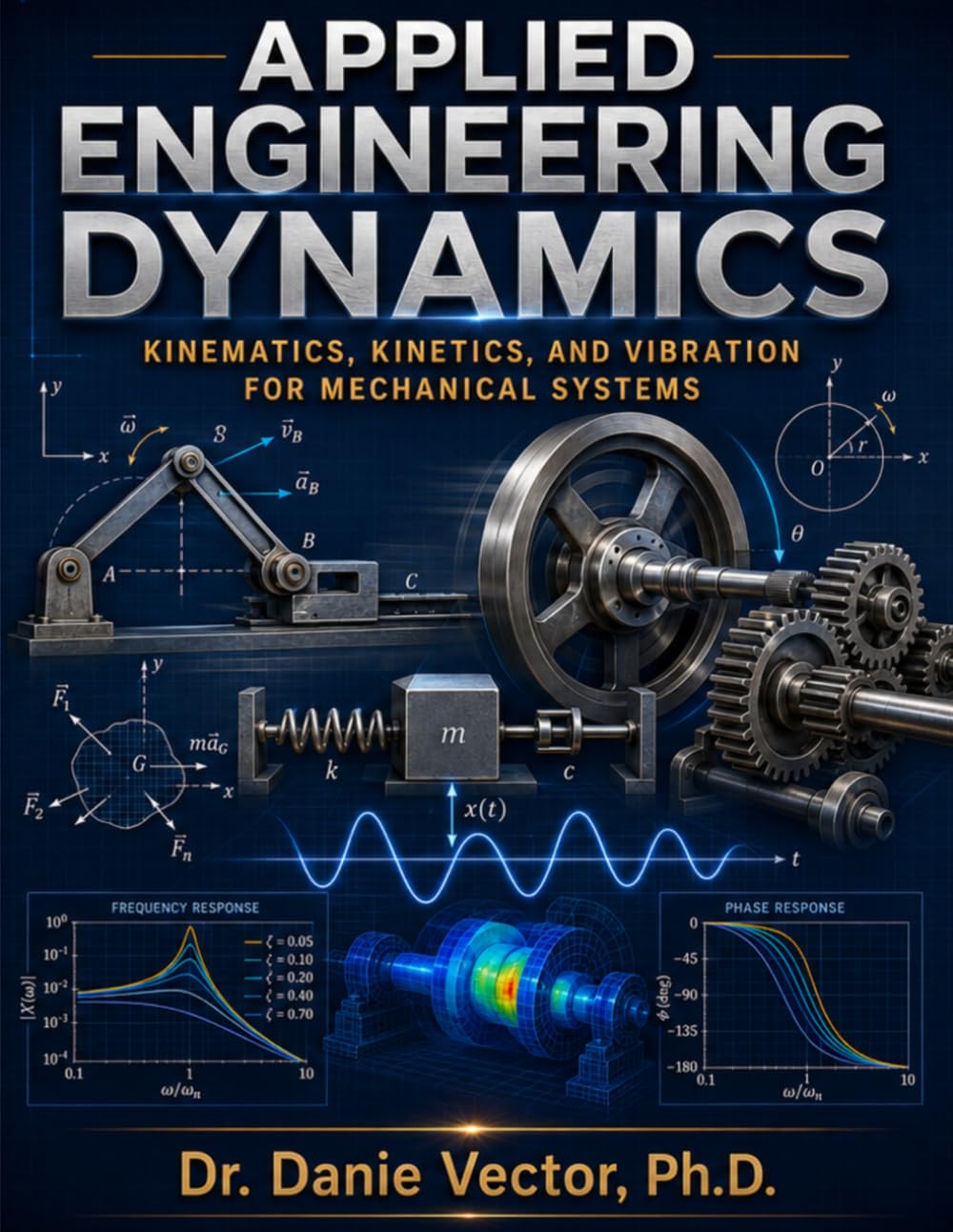
Applied Engineering Dynamics: Kinematics, Kinetics, and Vibration for Mechanical Systems kindle
por Dr. Danie Vector, Ph.D.



Descrição do livro
Dynamics sits beneath nearly every mechanical, aerospace, and civil specialty, yet few references treat the whole subject as one coherent structure rather than a stack of loosely related chapters. This comprehensive guide was built to be that single, dependable structure - a complete arc from the first description of motion to the design of systems that must move, rotate, and vibrate safely. Organized into a continuous fifteen-chapter progression, it develops particle kinematics and kinetics, extends every principle to rigid bodies in a plane and in three dimensions, and closes with vibration and an applied design capstone. Notation and terminology are fixed at the outset and used consistently throughout, so a symbol introduced early never quietly changes meaning later. Every chapter follows the same dependable shape: clear objectives, theory built from fundamentals, several fully worked examples, practice problems with boxed answers, and a summary of key equations. What you can rely on inside:- Complete coverage of motion analysis, from straight-line and curved particle paths to the full three-dimensional motion of rigid bodies.- A unified treatment of force, energy, and momentum methods, with clear guidance on when each is the right choice.- Thorough chapters on free, damped, and forced vibration, including rotating unbalance, isolation, transmissibility, and tuned-mass dampers.- A capstone that connects the entire toolkit to drive trains, vehicle dynamics, rotating machinery, rotor balancing, and structural vibration control.- Reference appendices covering mass moments of inertia, beam and shaft stiffness, material properties, and unit conversions, plus a glossary and symbol list for quick lookup. The subject matter reaches across the discipline: rectilinear, curvilinear, normal-tangential, and polar kinematics; relative and dependent motion; the equation of motion, work and energy, and impulse and momentum; moments and products of inertia and gyroscopic effects; and the full span of single- and multi-degree-of-freedom vibration. It is written for upper-level undergraduates who need a rigorous companion through a dynamics sequence and for practicing engineers who want a trustworthy desk reference they can return to for years. A working command of statics and calculus through ordinary differential equations is assumed.









Autores populares
Icon Group International (285) Publishing lmgdaw (262) Nikolay Krechet (164) Kennie B Journals (112) Riddler Books (98) Charles Nehme (95) webmarbook design (95) Mint and Cherry Notebooks (79) Iwona Makara (76) Mary Hirose (75) NAK Legal Publishing (74) Jillo Trukudo (73) Just Visualize It (69) Quick Witted Coconut (67) Talor Press (67) matlasor Sticker's (64) Miller Sye (63) Moonpeak Library (63) Ondrej Sarek (63) Roggie Clark (63)