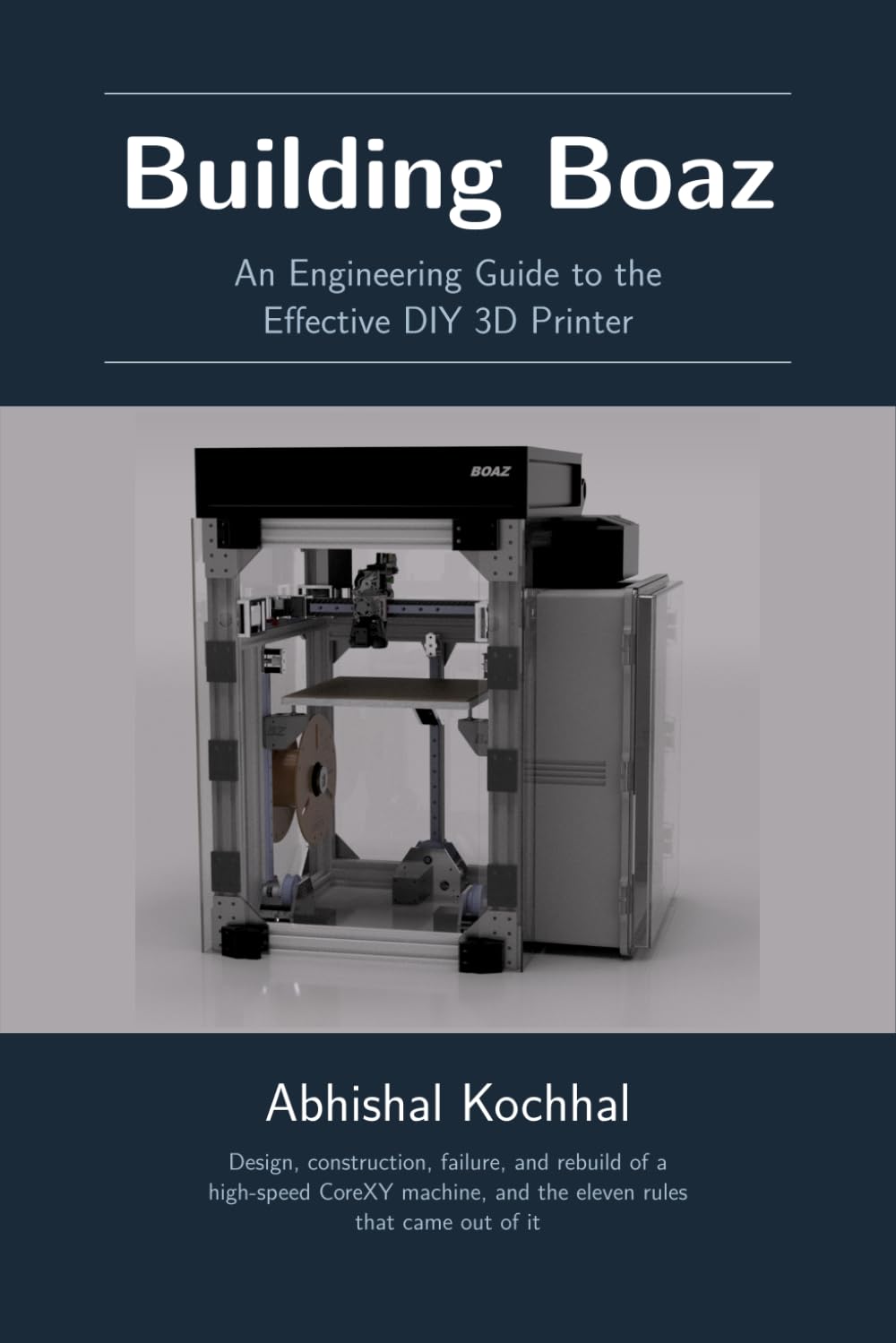
Building Boaz: An Engineering Guide to the Effective DIY 3D Printer ibook
por Abhishal Kochhal



Descrição do livro
Boaz: One CoreXY 3D Printer, Built TwiceThere is a particular disappointment that belongs to the person who builds their own 3D printer. You spend a year sourcing parts a hundred dollars at a time, you assemble something that looks like the CAD render, you press Print, and the part that comes off the bed is worse than what a $300 factory machine produces on its first attempt. This book argues that the disappointment is not a case against building. It is a case against building the way the hobby builds. Printed structural parts, idlers on M5 screws, rails aligned by eye: these conventions were inherited from a project whose goal was self-replication from the cheapest parts, not precision. Machine-tool builders solved the precision problem decades ago, with exact-constraint design, kinematic couplings, interference fits, and measurement as a construction step rather than an inspection step. Boaz is the record of applying those answers to one machine. Boaz was designed in 2023, built through 2024, and put to work: two hundred toys for a charity drive, a thousand pet-medicine boxes for a medical organisation in Iraq. Then it was taken apart. The first build had failed in almost every subsystem, and the failures were specific enough to teach: a dowel pin in a hole reamed too large, a PCB heatbed whose stiffness fought the rack meant to flatten it, a grease correctly specified by the rail maker and wrong for the job. The rebuild is where most of the engineering lives. Twenty-nine chapters take you from first principles to firmware. Why a frame must be stiff before it can be square. Why CoreXY, why belted Z, why a toolhead's centre of mass matters more than its weight. How to press a pin, tram a bed, read a resonance sweep as a report card on your assembly. Eight success criteria were fixed before construction and the rebuilt machine is scored against them in the open: seven met, one missed, and the production contract lost outright to a $300 commercial printer. Those numbers are in the book because published build logs are success narratives, and success narratives leave out what a builder most needs. The book is not a parts list. Boaz is a one-off, and some of its components need services not every reader has. What transfers is the method, compressed into eleven rules and a set of measurement procedures that will improve any machine you build, on any frame, with any kinematics. The most useful pages describe what did not work.










Autores populares
Icon Group International (285) Publishing lmgdaw (262) Nikolay Krechet (164) Kennie B Journals (112) Riddler Books (98) Charles Nehme (95) webmarbook design (95) Mint and Cherry Notebooks (79) Iwona Makara (76) Mary Hirose (75) NAK Legal Publishing (74) Jillo Trukudo (73) Just Visualize It (69) Quick Witted Coconut (67) Talor Press (67) matlasor Sticker's (64) Miller Sye (63) Moonpeak Library (63) Ondrej Sarek (63) Roggie Clark (63)