

Descrição do livro
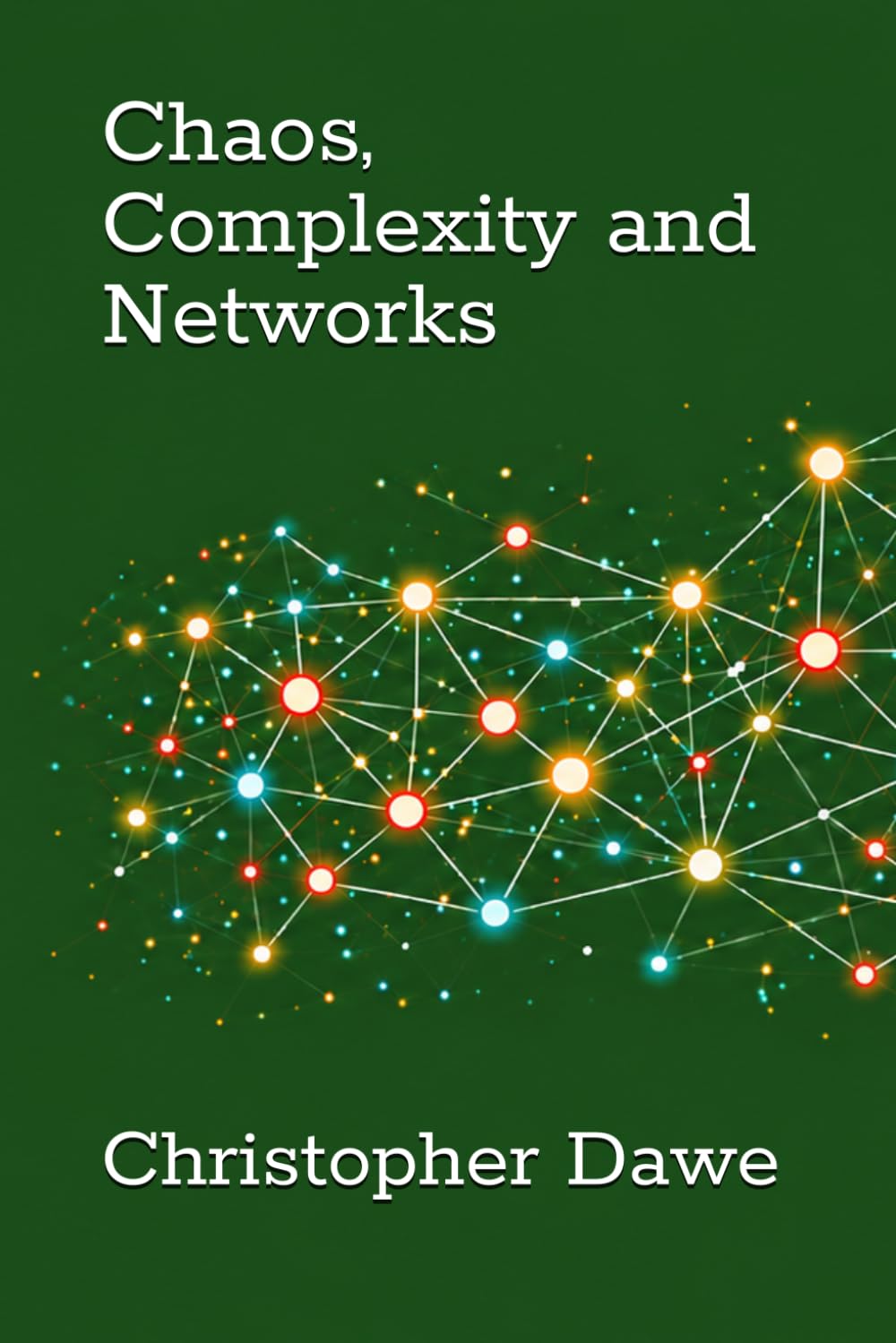
Chaos, Complexity and Networks
Why do some systems settle into stable, predictable order — a crystal, a clockwork mechanism, a well-run machine — while others spiral into unpredictable chaos? And why do the systems we find most fascinating, from ecosystems to economies to the human brain, so often sit somewhere in between?
This book traces the history of that question from its earliest roots to a genuinely new proposal for answering it.
It begins with Newton’s vision of a clockwork universe, governed entirely by fixed, predictable laws — and with a little-known irony: the same man who mapped the mechanism of the heavens spent decades hiding his own deepest, most heretical questions from the world. From there, the story moves through Henri Poincaré’s accidental discovery of chaos, buried inside a prize-winning paper he was forced to recall and rewrite; Edward Lorenz’s famous rounding error, made over a cup of coffee, that gave the world the “butterfly effect”; and Mitchell Feigenbaum’s discovery of a universal constant, found using nothing more than a slow pocket calculator. Along the way, the book charts the rise of complexity science and the emergence of network theory as a way of understanding systems built not from isolated parts, but from webs of relationship.
The book’s second half turns from history to an original idea. Drawing on the argument that relationships — not the objects they connect — carry the deepest explanatory power, it proposes a new measure of complexity: the Connectivity Ratio. Rather than resting on analogy alone, the book puts this proposal to a real, worked test using a genuine physical case — the structural difference between crystalline and glassy silica — and includes a working simulation appendix, with actual code, so readers can test the framework’s predictions for themselves.
Written for anyone curious about the mathematics of order and disorder, this book is both a rigorous history of chaos and complexity theory and a candid, testable proposal for where that history might lead next — including an honest reckoning, in its final chapter, of exactly what has and has not yet been proven.








Autores populares
Icon Group International (285) Publishing lmgdaw (262) Nikolay Krechet (164) Kennie B Journals (112) Riddler Books (98) Charles Nehme (95) webmarbook design (95) Mint and Cherry Notebooks (79) Iwona Makara (76) Mary Hirose (75) NAK Legal Publishing (74) Jillo Trukudo (73) Just Visualize It (69) Quick Witted Coconut (67) Talor Press (67) matlasor Sticker's (64) Miller Sye (63) Moonpeak Library (63) Ondrej Sarek (63) Roggie Clark (63)