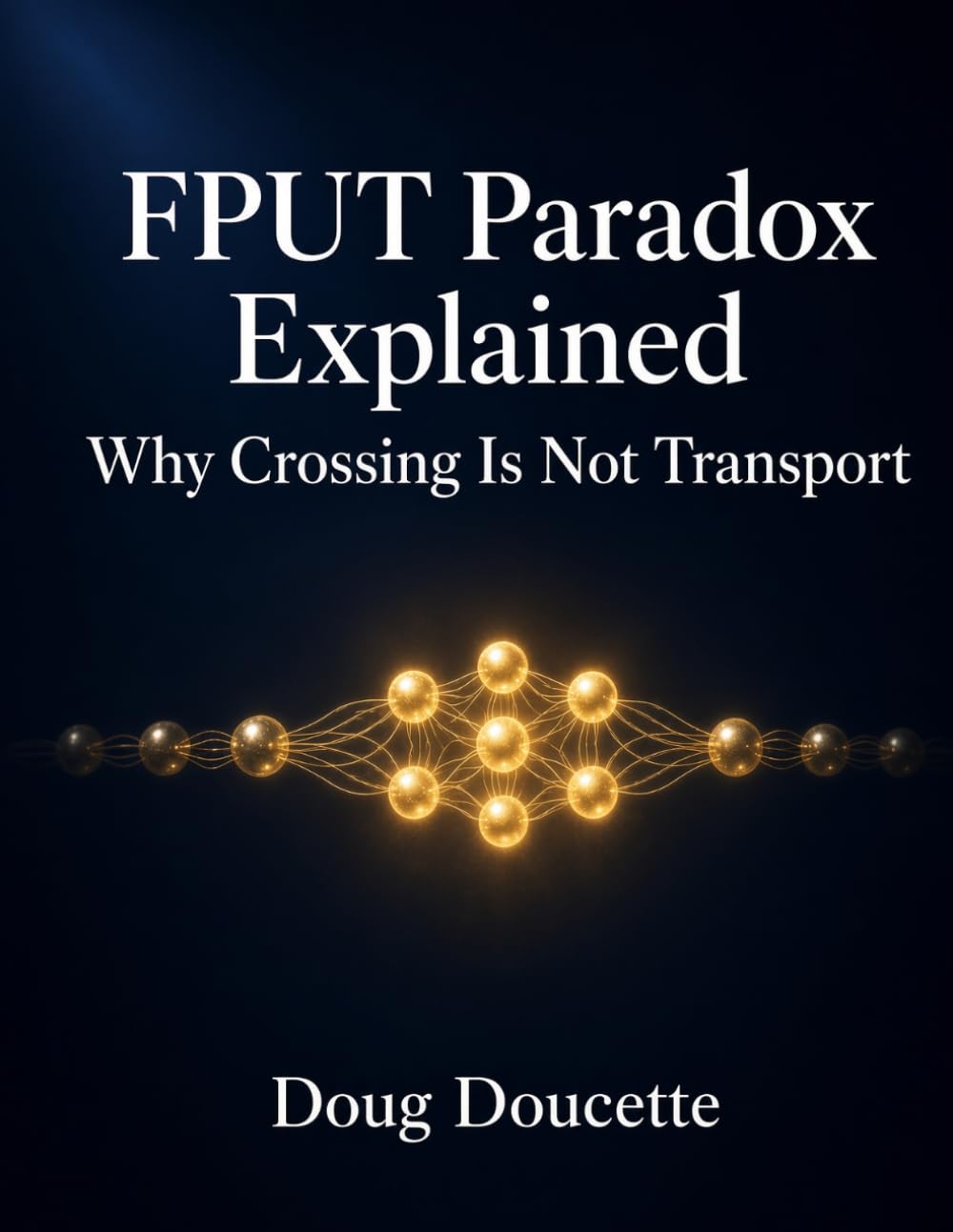
FPUT Paradox Explained: Why Coupling Is Not Transport kindle
por Doug M Doucette



Descrição do livro
This book reinterprets the Fermi–Pasta–Ulam–Tsingou (FPUT) paradox through the Trojan framework of protected nonlinear coherence. The classic puzzle—that a weakly nonlinear oscillator chain, started in a low-frequency mode, fails to thermalize and instead returns near its initial state—is reframed as a problem of transport rather than mere nonlinearity. Coupling exists; what is surprising is that it does not immediately become global modal transport. The central claim is local, structural, and finite-time: near low-mode recurrent states and q-breather periodic orbits, FPUT dynamics exhibit a coherent modal backbone, near-integrable normal-form organization, suppressed action drift, and exit through resonance. Nonlinear coupling is present but geometrically contained. Recurrence is therefore protected nonlinear coherence; eventual thermalization is resonant thickening of that coherence. Two pillars of evidence support the argument. Optical experiments by Pierangeli et al. demonstrate more than three FPUT-type recurrences in nonlinear spatial waves, controlled by amplitude and phase and governed by exact nonlinear Schrödinger recurrence laws; recurrence vanishes as integrability is lost. In the discrete lattice, q-breathers—localized periodic orbits continued from linear normal modes—supply the internal Trojan skeleton. Floquet stability, exponential modal localization, and resonance-driven bifurcations into composite periodic orbits show how protection persists and how it fails. Resonances of the form ω1=kωm \omega_1 = k\omega_m ω1=kωm collapse normal-form divisors, open transport channels, and enlarge the coherent packet without instant equipartition. The book develops precise diagnostics: coherent modal blocks and failure regions, the FPUT thinness ratio measuring leakage against a failure margin, finite-time confinement estimates, spectral entropy as a transport observable, recurrence fidelity, and a transport-graph formulation of connectivity. A conditional admission criterion states when a recurrent or metastable regime satisfies Trojan architecture. Falsification criteria are given so the interpretation remains testable. A final chapter extends the same transport logic to intramolecular vibrational energy redistribution. The thinness ratio distinguishes formal anharmonic coupling from chemically effective IVR, identifies a selectivity window, and shows why Fermi resonances may remain thin or become thick depending on network connectivity and chemical timescale. The contribution is synthetic rather than a new global solution of FPUT. Existing results on solitons, Toda dynamics, q-breathers, NLSE recurrence, and metastability are organized under one architecture: stability is the containment of transport; thermalization begins when coupling acquires reach. FPUT thereby becomes a model case of protected nonlinear coherence rather than an isolated historical anomaly.









Autores populares
Icon Group International (285) Publishing lmgdaw (262) Nikolay Krechet (164) Kennie B Journals (112) Riddler Books (98) Charles Nehme (95) webmarbook design (95) Mint and Cherry Notebooks (79) Iwona Makara (76) Mary Hirose (75) NAK Legal Publishing (74) Jillo Trukudo (73) Just Visualize It (69) Quick Witted Coconut (67) Talor Press (67) matlasor Sticker's (64) Miller Sye (63) Moonpeak Library (63) Ondrej Sarek (63) Roggie Clark (63)