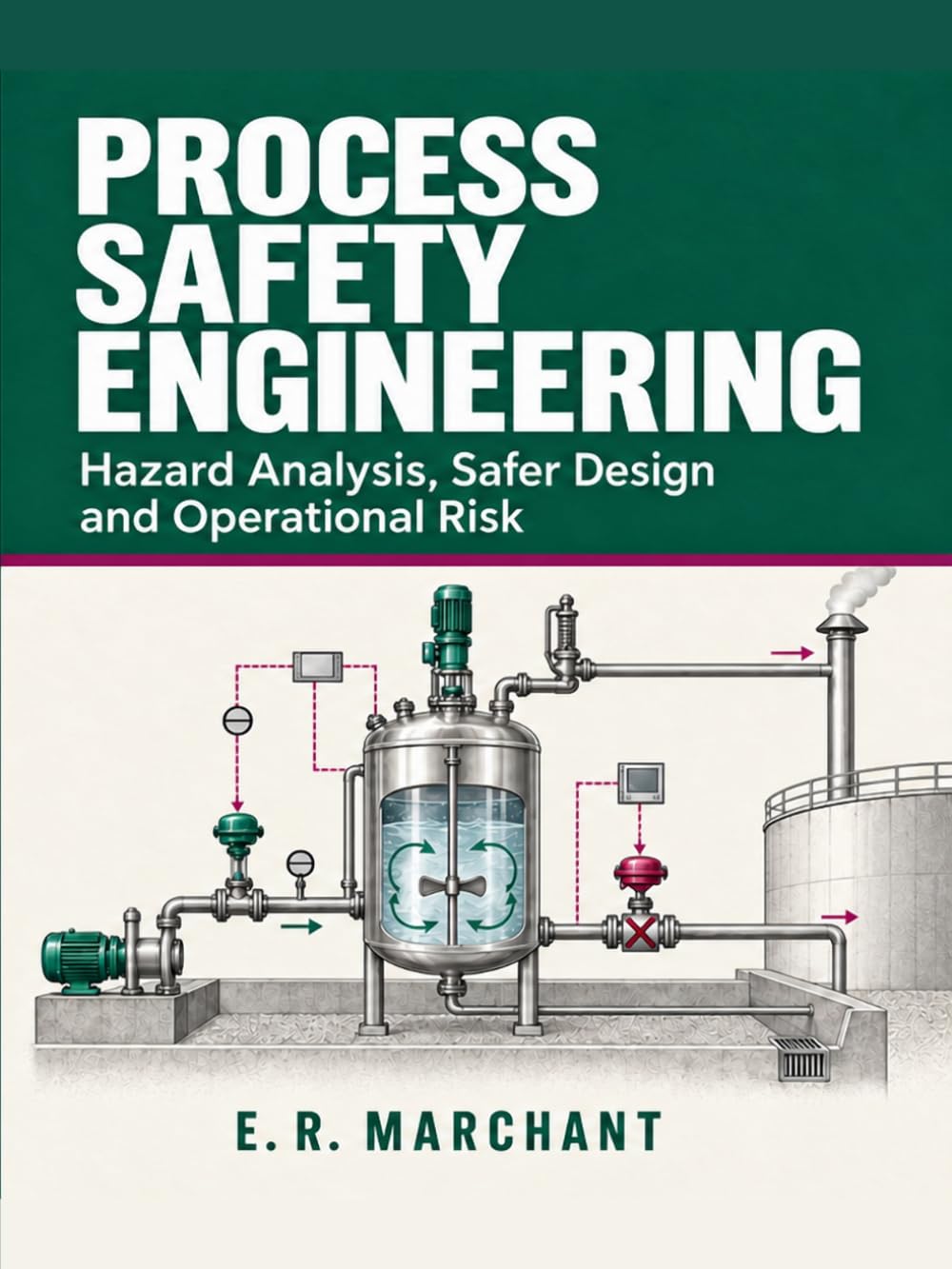
Process Safety Engineering: Hazard Analysis, Safer Design and Operational Risk kindle
por E. R. Marchant



Descrição do livro
How can an engineer recognise the path from a routine process deviation to a major accident, and what evidence shows that the safeguards will work when they are needed? Process Safety Engineering builds the subject around five questions: what can go wrong, how serious the consequences could be, how hazards can be reduced, which safeguards are needed, and how protection is maintained throughout plant life. It distinguishes process safety from occupational safety while showing where they connect, and it uses hazard, risk, consequence, likelihood, exposure, safeguard and barrier consistently. Starting from chemical and physical hazards, the book develops fire, explosion, toxic-release and reactive-hazard fundamentals from first principles. It then introduces inherently safer design, HAZID, HAZOP, bow tie analysis, fault trees, event trees, LOPA and quantitative risk assessment at an appropriate first-course depth. Inputs, assumptions, outputs and limitations remain visible, helping readers choose methods for the decisions they need to make. Readers will learn how to: A consistent hypothetical process carries engineering decisions across all 16 chapters. Fully worked calculations and design comparisons are integrated into the narrative, supported by 112 original process schematics, bow ties, fault and event trees, consequence plots and management workflows. Verified incident investigations are treated separately from the hypothetical examples, with documented findings, uncertainty and interpretation clearly identified. UK context includes COMAH, DSEAR, pressure-systems requirements and ALARP, with Great Britain and Northern Ireland distinguished where relevant. The text does not treat a risk-matrix colour or low personal-injury rate as proof that major-accident risk is controlled. Written for advanced undergraduate chemical and process engineering students taking a first process safety course, and for early-career engineers entering process industries. Introductory chemistry, thermodynamics, fluid mechanics, material and energy balances and elementary probability are assumed. Simplified examples are educational demonstrations, not plant design calculations or operating instructions.









Autores populares
Icon Group International (285) Publishing lmgdaw (262) Nikolay Krechet (164) Kennie B Journals (112) Riddler Books (98) Charles Nehme (95) webmarbook design (95) Mint and Cherry Notebooks (79) Iwona Makara (76) Mary Hirose (75) NAK Legal Publishing (74) Jillo Trukudo (73) Just Visualize It (69) Talor Press (68) Quick Witted Coconut (67) matlasor Sticker's (64) Miller Sye (63) Moonpeak Library (63) Ondrej Sarek (63) Roggie Clark (63)