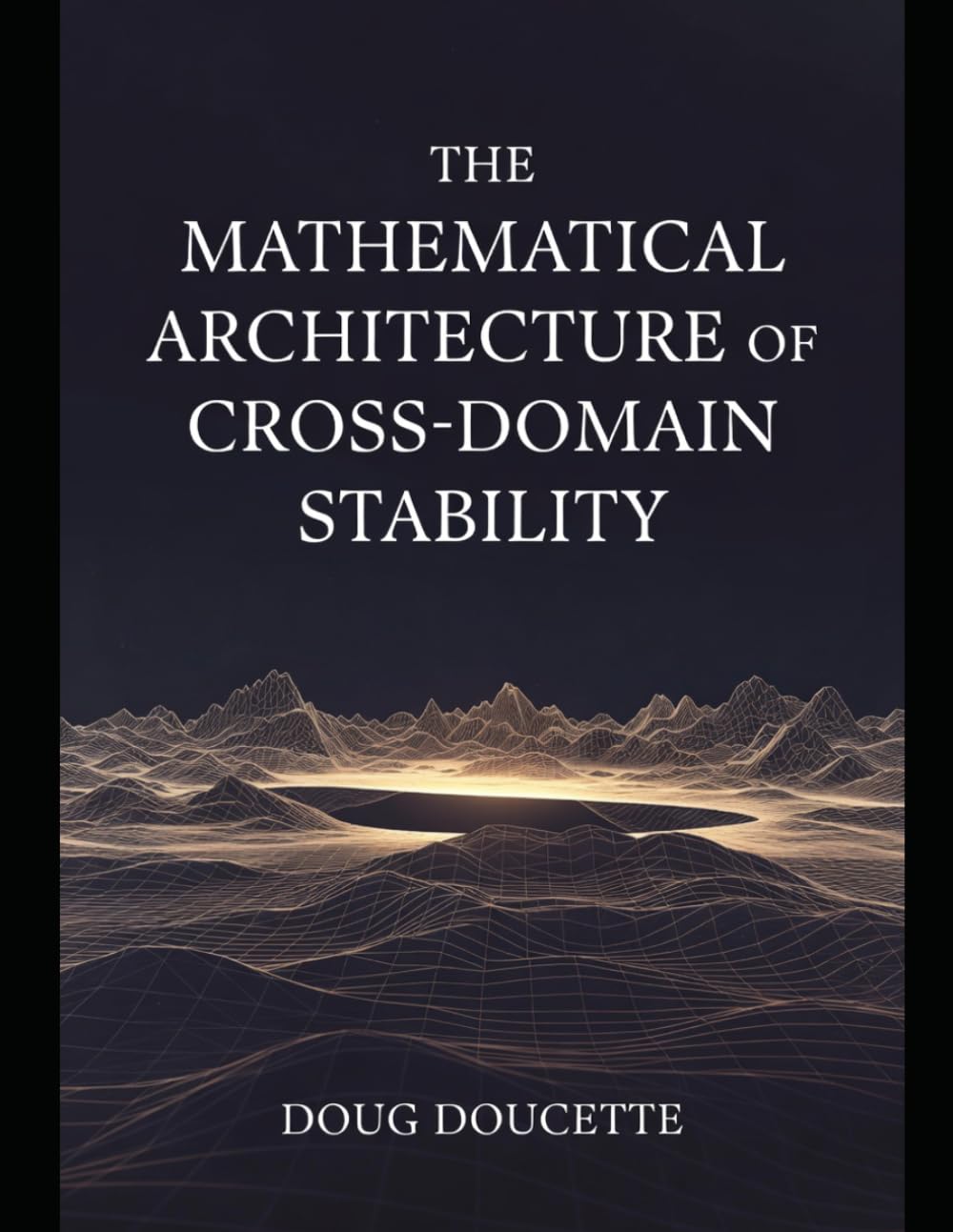
The Mathematical Architecture of Cross-Domain Stability kindle
por Doug M Doucette



Descrição do livro
The Mathematical Architecture of Cross-Domain Stability by Doug Doucette presents the rigorous mathematical foundation of the Trojan Universality Class. It demonstrates that long-lived coherence in nonlinear systems is produced by a single, repeatable dynamical architecture rather than domain-specific tricks or statistical accident. At the heart of the book is the Terminal Object Theorem: the normalized CR3BP Hamiltonian at the triangular Lagrange point L4. L4 is a terminal object in the category of spectrally gapped elliptic-elliptic Hamiltonian germs in two degrees of freedom. For every system in this category, there exists a local symplectomorphism to the Trojan normal form whose constants are controlled by the spectral gap parameter. This categorical result licenses the direct transfer of Nekhoroshev-type stability estimates, resonance geometry, and thinness diagnostics across widely different physical contexts while clearly delimiting what cannot be transferred. The thin/thick chaos framework supplies the operational complement. Stability is defined as the non-reachability of failure regions in coherence-relevant variables. The thinness index quantifies how much projected transport occurs relative to the distance to failure. Thin chaos—local instability without operational reach—is certified when the index remains below unity; thick chaos appears when transport pathways connect to failure. The framework proves that normal-form remainder bounds translate directly into operational safety margins. A precise ten-stage admission test determines whether a candidate system belongs to the Trojan Universality Class, producing graded classifications from strict membership to applied Trojan organization, near-Trojan behavior, transitional exit, or non-Trojan coherence. The Trojan Robustness Index compresses resonance margin, remainder size, extra-mode coupling, and noise into a single, measurable design metric. The Structural Exit Theorem shows that departure from the class occurs through one or more of four exhaustive mechanisms—separatrix splitting, resonance overlap, spectral-gap collapse, or activation of additional modes—thereby supplying both early-warning diagnostics and design principles. Applications are examined across celestial mechanics (the historical prototype), nonlinear optics, molecular vibrational dynamics, engineered micro-resonators, and physiological rhythms, with claims carefully graded to the strength of evidence available in each domain. Epistemic consequences include structured ignorance bounds that permit stability predictions when full equations are unknown, and the disciplined use of known Trojan systems as analog laboratories. The book states its limits with equal precision: two degrees of freedom, locality, finite order, conservative dynamics, and conditional membership. The central conclusions are that stability is containment, chaos possesses thickness as well as intensity, entropy may be locally real yet operationally thin, universality can be local and geometric, and failure is structural exit from a protective architecture. Full proofs, spectral properties, and technical appendices support every claim. Intended for researchers in dynamical systems, Hamiltonian mechanics, and applied fields where coherence is essential, the work offers a falsifiable, transferable mathematical lens rather than a universal explanation for all persistence.








Autores populares
Icon Group International (285) Publishing lmgdaw (262) Nikolay Krechet (164) Kennie B Journals (112) Riddler Books (98) Charles Nehme (95) webmarbook design (95) Mint and Cherry Notebooks (79) Iwona Makara (76) Mary Hirose (75) NAK Legal Publishing (74) Jillo Trukudo (73) Just Visualize It (69) Quick Witted Coconut (67) Talor Press (67) matlasor Sticker's (64) Miller Sye (63) Moonpeak Library (63) Ondrej Sarek (63) Roggie Clark (63)