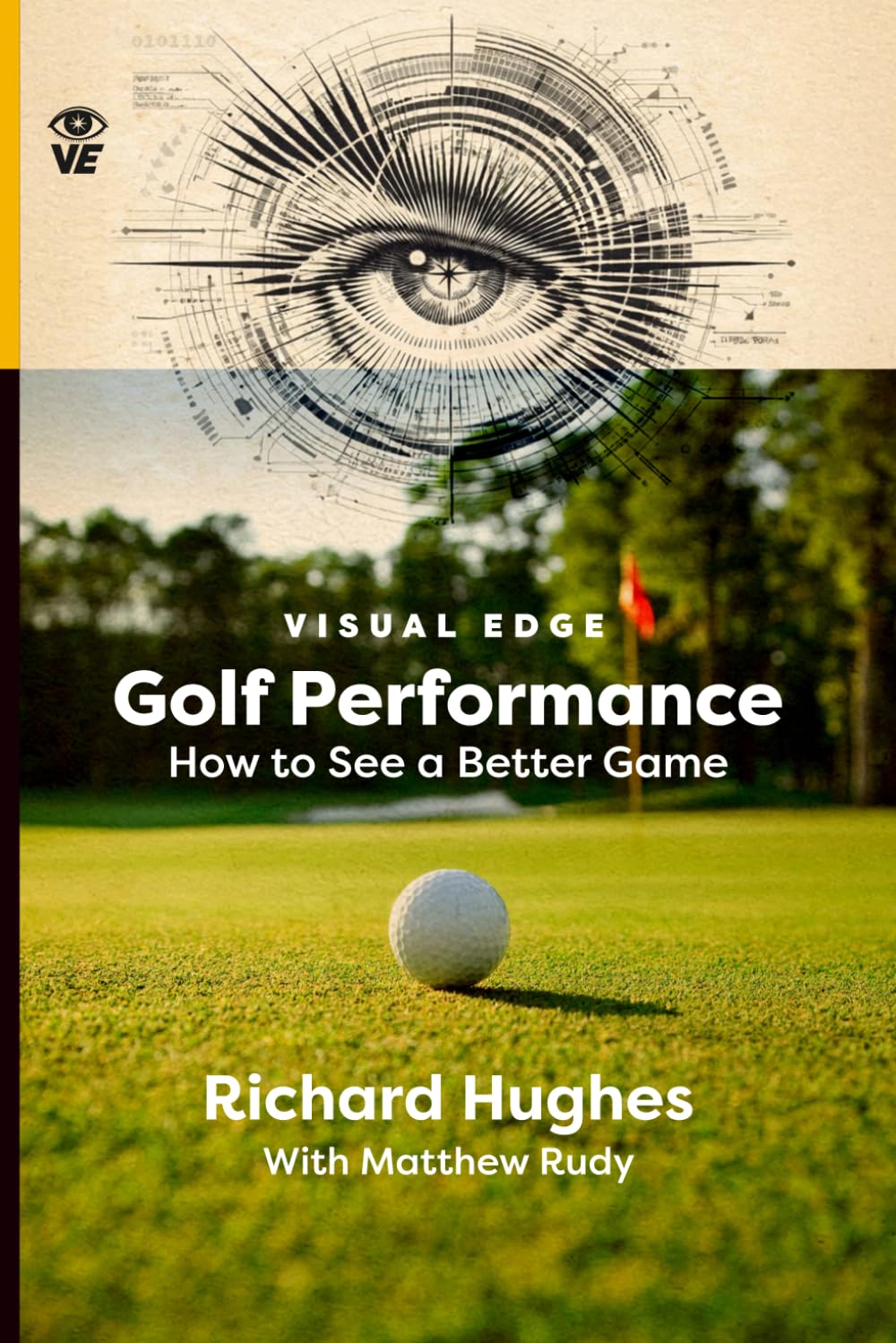
Visual Edge Golf Performance: How to See a Better Game ibook
por Richard Hughes



Descrição do livro
Why do golfers with sound mechanics, dedicated practice, and real athletic ability often fall short of their potential? For more than a century, golf instruction has obsessed over the mechanics of the swing. Grip, stance, path, face angle, tempo—the game has built an extraordinary vocabulary for what the body does. What has yet to be fully explored is what the eyes do, and how the relationship between a player’s eye dominance and handedness shapes everything from setup and alignment to ball-striking and putting. Visual Edge Golf Performance: How to See a Better Game is the first book dedicated entirely to this relationship. It introduces a clinically grounded, immediately practical framework built around a distinction that golf instruction has never formally mapped: the difference between Type I players (eye dominance and handedness on the same side) and Type II players (cross-dominant). The difference matters more than most golfers suspect. Research Hughes and his colleagues conducted found that while roughly seventy percent of the general population is same-side dominant, more than fifty percent of the elite tour professionals they assessed were cross-dominant. That means much of the technical vocabulary that defines modern golf instruction was not designed for the majority of recreational golfers. Players have often been grinding against a system that wasn't built for them. Understanding your visual type gives you a new framework for practice, setup, and course management that works with how your brain and body actually process what your eyes see. “Golf swings are not mechanical systems executing a fixed program. They are human performances. And humans are wildly different from one another in ways that go far deeper than their mechanics, their body types and their levels of athleticism. I can see similarities in Richard’s research journey to my own, where ‘we don’t know’ isn’t an answer to accept but one to challenge with more questions, more work and more collaboration.” “What Richard Hughes and researchers like him are doing is bringing structure to sport vision. If you can show a player—concretely, in real time—what their visual system is doing and how it connects to what is happening in their game, the compliance problem changes. The moment of recognition is what makes the work stick.” “My brain had learned to compensate by remembering where things should be rather than actually seeing them. It was like playing golf from memory rather than from sight. Now, I can just play. I can trust what I see.” Richard Hughes is a sport vision optometrist based in Galway, Ireland, with more than two decades of experience working with elite athletes across disciplines—including Formula 1, international rugby, soccer, Gaelic football, racquet sports, and elite amateur and professional golf. His clinical practice focuses on the intersection of ocular function, eye dominance, and athletic performance, with particular specialization in the visual mechanics of golf. Matthew Rudy Golf Digest’s Senior Instruction Writer for more than twenty years. He has collaborated on books with some of the game’s most respected coaches, including Mark Blackburn, Bernie Najar, Stan Utley, Dave Stockton, and Hank Haney.
— Michael Jacobs, Golf Digest Top 10 Teacher; Golf Magazine Top 100 Teacher; 2025 PGA National Professional Development Award Winner
— Padraig Harrington, Three-Time Major Champion; World Golf Hall of Fame Inductee
— Peter Lawrie, DP World Tour Winner






Autores populares
Icon Group International (285) Publishing lmgdaw (262) Nikolay Krechet (164) Kennie B Journals (112) Riddler Books (98) Charles Nehme (95) webmarbook design (95) Mint and Cherry Notebooks (79) Iwona Makara (76) Mary Hirose (75) NAK Legal Publishing (74) Jillo Trukudo (73) Just Visualize It (69) Talor Press (68) Quick Witted Coconut (67) matlasor Sticker's (64) Miller Sye (63) Moonpeak Library (63) Ondrej Sarek (63) Roggie Clark (63)