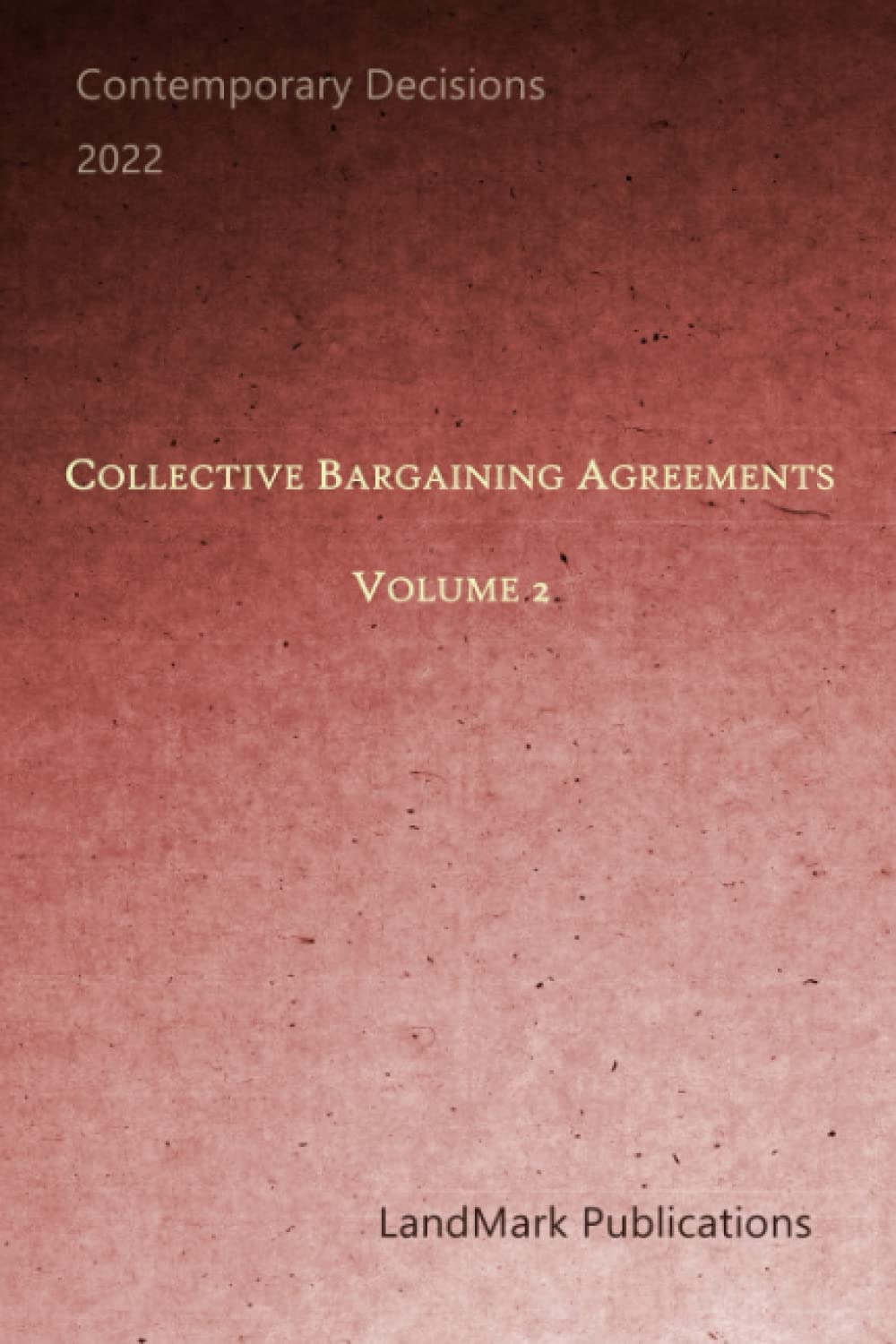
Collective Bargaining Agreements: Volume 2 epub
por LandMark Publications



Descrição do livro
THIS CASEBOOK contains a selection of U. S. Court of Appeals decisions that analyze and discuss issues surrounding collective bargaining agreements. Volume 2 of the casebook covers the Sixth through the Eleventh Circuit Court of Appeals.
* * *
To preserve the effectiveness of labor arbitration and promote uniformity in labor disputes, § 301 of the LMRA provides: "Suits for violation of contracts between an employer and a labor organization representing employees in an industry affecting commerce . . . may be brought in any district court of the United States having jurisdiction of the parties. . . ." 29 U.S.C. § 185(a). When it enacted § 301, "Congress intended doctrines of federal labor law uniformly to prevail over inconsistent local rules." Allis-Chalmers Corp., 471 U.S. at 209-10, 105 S.Ct. 1904 (quoting Lucas Flour Co., 369 U.S. at 104, 82 S.Ct. 571). Therefore, "a suit in state court alleging a violation of a provision of a labor contract must be brought under § 301 and be resolved by reference to federal law." Id. at 210, 105 S.Ct. 1904. The complete preemption doctrine, applied "primarily in cases raising claims pre-empted by § 301 of the LMRA," holds that "[o]nce an area of state law has been completely pre-empted, any claim purportedly based on that pre-empted state law is considered, from its inception, a federal claim, and therefore arises under federal law." Caterpillar Inc. v. Williams, 482 U.S. 386, 393, 107 S.Ct. 2425, 96 L.Ed.2d 318 (1987).
The Supreme Court has also explained the necessarily broad reach of preemption in the labor law context. "If the policies that animate § 301 are to be given their proper range, however, the pre-emptive effect of § 301 must extend beyond suits alleging contract violations." Allis-Chalmers Corp., 471 U.S. at 210, 105 S.Ct. 1904. To create uniformity, courts must not "elevate form over substance and allow parties to evade the requirements of § 301 by relabeling their contract claims as claims for tortious breach of contract." Id. at 211, 105 S.Ct. 1904. Plaintiffs may not evade preemption by failing to plead "necessary federal questions." Rivet v. Regions Bank of La., 522 U.S. 470, 475, 118 S.Ct. 921, 139 L.Ed.2d 912 (1998) (quoting Franchise Tax Bd. of Cal. v. Constr. Laborers Vacation Tr. for S. Cal., 463 U.S. 1, 22, 103 S.Ct. 2841, 77 L.Ed.2d 420 (1983)). "The artful pleading doctrine allows removal where federal law completely preempts a plaintiff's state-law claim." Id.; see also Avco Corp. v. Aero Lodge No. 735, Int'l Ass'n of Machinists, 390 U.S. 557, 560, 88 S.Ct. 1235, 20 L.Ed.2d 126 (1968) (upholding removal based on § 301 preemption).
Adamo Demolition v. Int'l Union of Operating Eng'r, 3 F. 4th 866 (6th Cir. 2021)









Autores populares
Icon Group International (285) Publishing lmgdaw (262) Nikolay Krechet (210) Kennie B Journals (112) Evgeniia Naumchenko (101) Riddler Books (98) Charles Nehme (96) NAK Legal Publishing (96) webmarbook design (95) Unknown Author (84) Mint and Cherry Notebooks (79) Iwona Makara (76) Mary Hirose (75) Jillo Trukudo (73) Vários Autores (71) Various (70) Just Visualize It (69) Quick Witted Coconut (67) Talor Press (67) matlasor Sticker's (64)