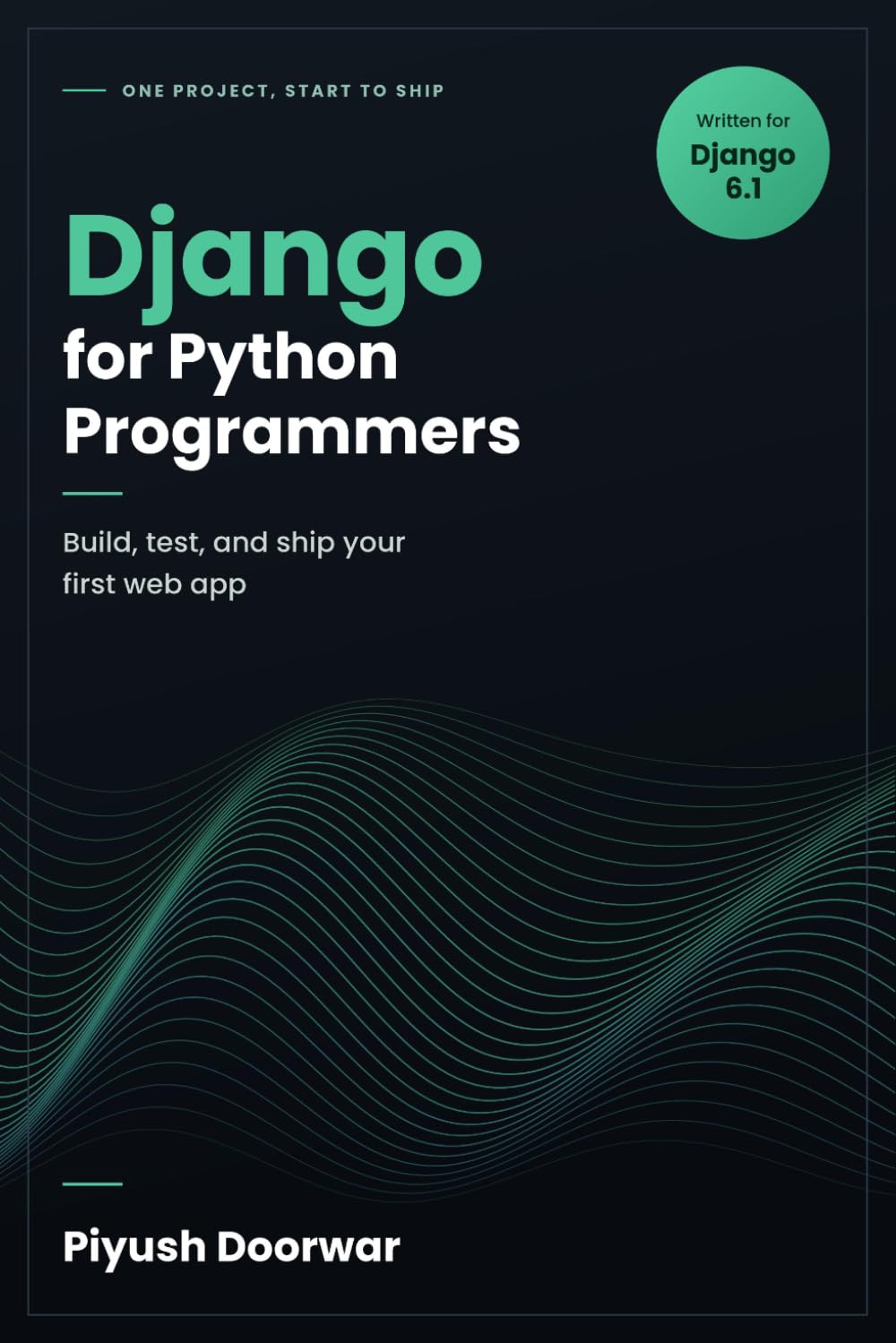
Django for Python Programmers: Piyush Doorwar epub
por Piyush Doorwar



Descrição do livro
You know Python. Now build something people can open. You can write a function, loop over a list, and read a traceback. The next thing you want to build is something other people can use, which means a web framework. You have heard of Django, opened its documentation, met the word middleware, and closed the tab. This book starts there. One project, from an empty directory to a live URL. You build Sidenote, a blog with a newsletter: posts, tags, cover images, comments that get moderated before they appear, a second writer allowed to draft but not publish, a confirmed-opt-in mailing list, a test suite, and a deployment. Every chapter adds to the same codebase, so you finish with one real application instead of twelve half-built tutorials in twelve folders. Written for Django 6.1. That matters more than it usually does. Django 6.1 deprecated a set of patterns almost every Django tutorial still teaches: bare select_related(), values_list(flat=True) with no field name, and the entire block of EMAIL_* settings, now replaced by MAILERS. Follow an older book on a fresh install and your terminal fills with warnings it cannot explain. Here you learn the current way, and you are shown the old way once, clearly labelled, because you will inherit it in somebody else's codebase. Assumes you can write a Python function and a class. It does not teach Python. It teaches everything web-shaped, from the raw HTTP request onwards. 15 chapters. One project. A URL at the end.











Autores populares
Icon Group International (285) Publishing lmgdaw (262) Nikolay Krechet (164) Kennie B Journals (112) Riddler Books (98) Charles Nehme (95) webmarbook design (95) Mint and Cherry Notebooks (79) Iwona Makara (76) Mary Hirose (75) NAK Legal Publishing (74) Jillo Trukudo (73) Just Visualize It (69) Talor Press (68) Quick Witted Coconut (67) matlasor Sticker's (64) Miller Sye (63) Moonpeak Library (63) Ondrej Sarek (63) Roggie Clark (63)