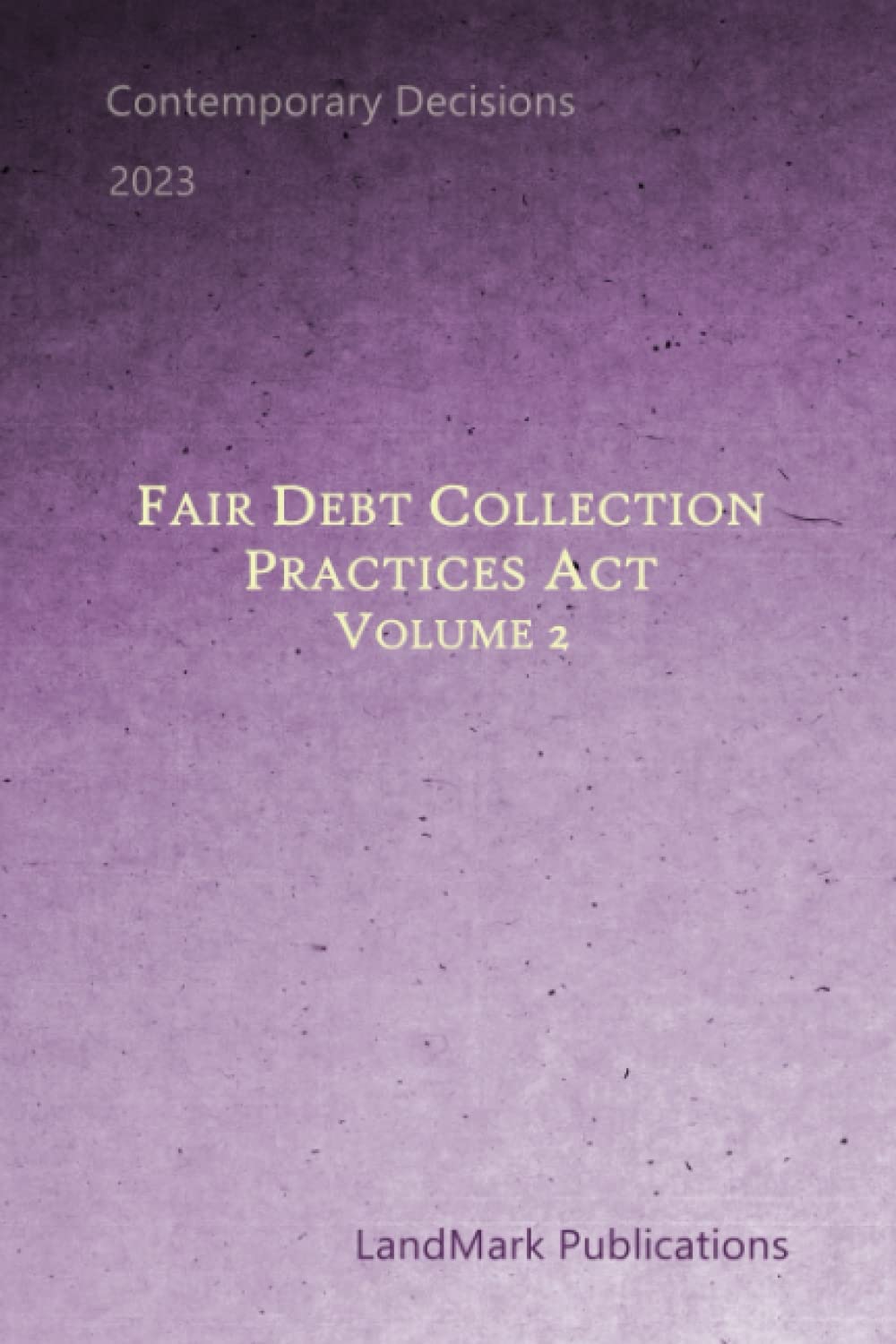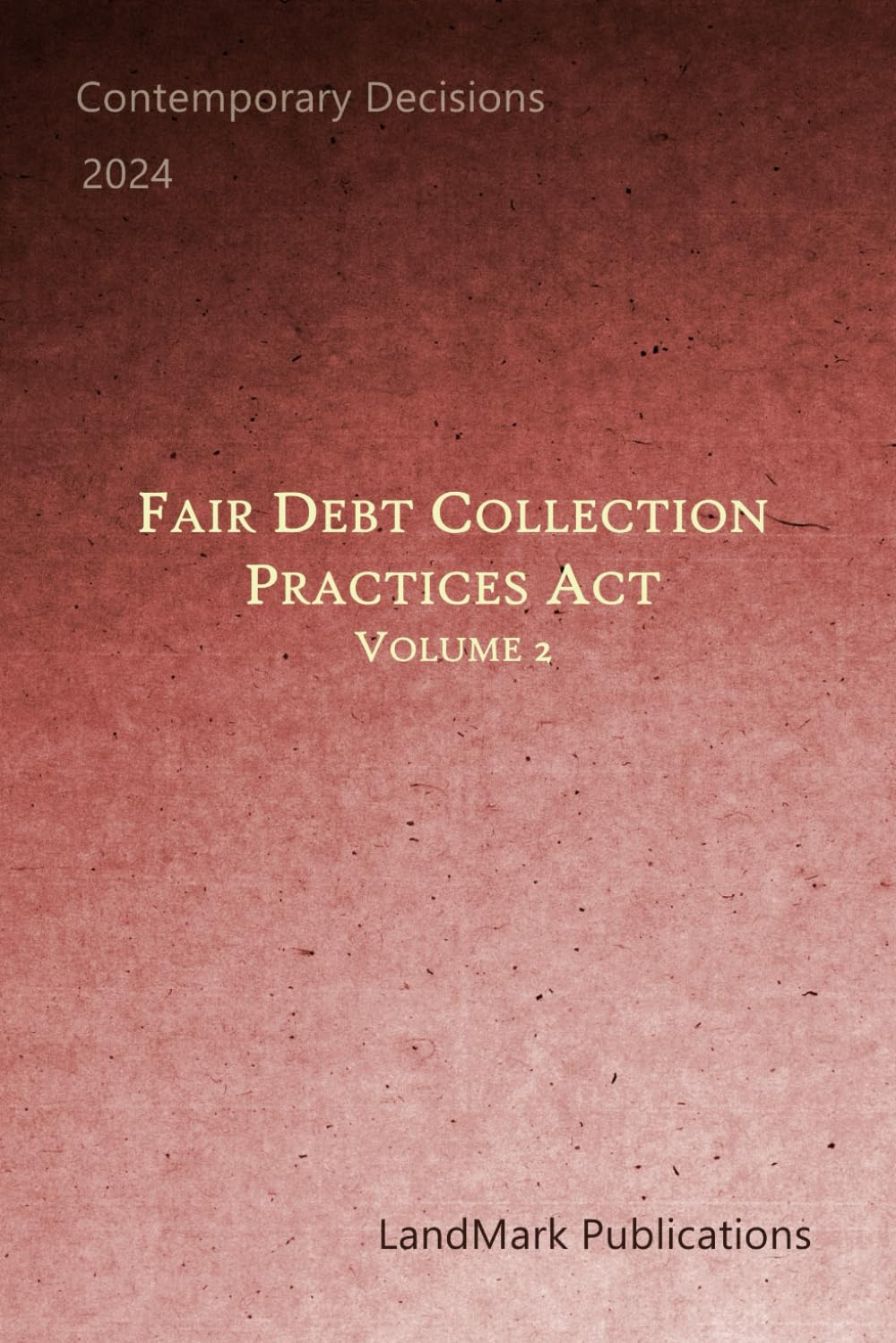
Fair Debt Collection Practices Act: Volume 2 ibook
por LandMark Publications

Descrição do livro
THIS CASEBOOK contains a selection of U. S. Court of Appeals decisions that analyze, discuss and interpret provisions of the Fair Debt Collection Practices Act. Volume 2 of the casebook covers the Sixth through the Eleventh Circuit Court of Appeals.
* * *
Congress enacted the FDCPA "to eliminate abusive debt collection practices by debt collectors, to insure that those debt collectors who refrain from using abusive debt collection practices are not competitively disadvantaged, and to promote consistent State action to protect consumers against debt collection abuses." 15 U.S.C. § 1692(e). To achieve those purposes, the FDCPA places limits on debt collection practices, and it provides a private right of action that allows successful plaintiffs to recover damages for certain violations. Id. § 1692k.
Under the FDCPA, debt collectors cannot use false, deceptive, or misleading representations, or unfair or unconscionable means in attempting to collect a debt. See id. §§ 1692e, 1692f. The statutory text for both § 1692e and § 1692f provides examples of practices that violate these prohibitions, but the text makes clear the examples are non-exhaustive. Id. § 1692e ("Without limiting the general application of the foregoing, the following conduct is a violation of this section."); id. § 1692f (same). Among the example violations of § 1692e are the failure to use the debt collector's "true name" and the use of false representations to attempt to collect any debt or obtain information concerning a consumer. Id. § 1692e(14), (10).
To prevail on a FDCPA claim, a plaintiff must prove four elements: (1) the plaintiff is a "consumer" under id. § 1692a(3); (2) the debt at issue arose out of a transaction entered into primarily for personal, family, or household purposes; (3) the defendant is a debt collector under id. § 1692a(6); and (4) through its acts or omissions, the defendant violated the FDCPA. Douglass v. Convergent Outsourcing, 765 F.3d 299, 303 (3d Cir. 2014); see also Maynard v. Cannon, 401 F. App'x 389, 393 (10th Cir. 2010).
Tavernaro v. Pioneer Credit Recovery, Inc., 43 F. 4th 1062 (10th Cir. 2022)





Autores populares
Icon Group International (285) Publishing lmgdaw (262) Nikolay Krechet (210) Kennie B Journals (112) Evgeniia Naumchenko (101) Riddler Books (98) Charles Nehme (96) NAK Legal Publishing (96) webmarbook design (95) Unknown Author (84) Mint and Cherry Notebooks (79) Iwona Makara (76) Mary Hirose (75) Jillo Trukudo (73) Vários Autores (71) Various (70) Just Visualize It (69) Quick Witted Coconut (67) Talor Press (67) matlasor Sticker's (64)